Comparing Free vs. Paid QR Code Solutions for SMEs
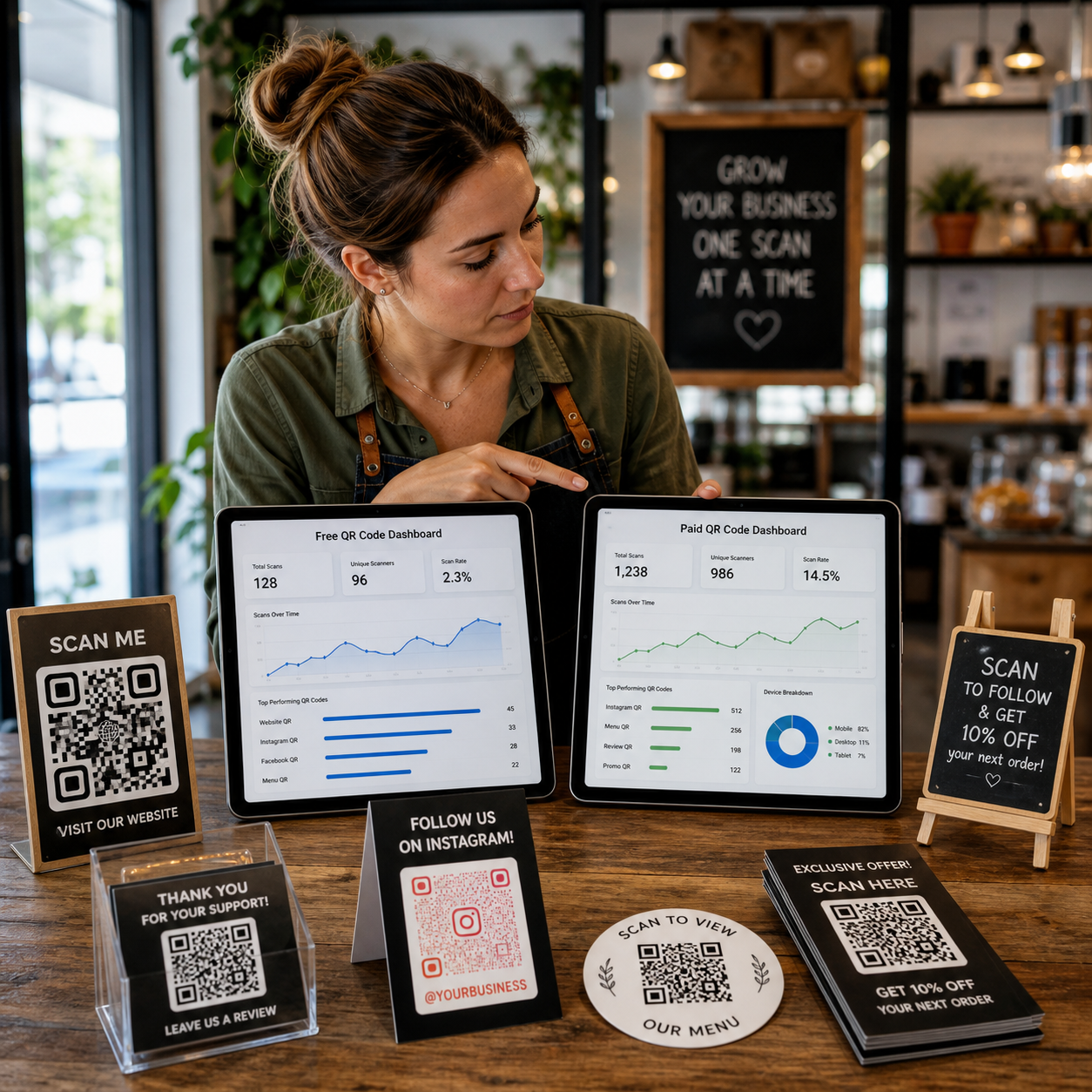
QR codes can connect a printed menu, product package, poster, or receipt to a mobile experience in seconds. For a small or medium-sized enterprise, the difficult choice is rarely whether to use a QR code. It is whether a basic free QR code generator provides enough control, or whether a paid QR code platform will save time and produce better marketing insight.
The right decision depends on the campaign’s lifespan, update frequency, tracking requirements, branding goals, team size, and growth plans. A one-time event may need only a static QR code, while an ongoing product campaign can benefit from a dynamic QR code, an editable destination URL, QR code analytics, and marketing integrations.
Free vs. Paid QR Codes: What Is the Difference?
A free QR code solution usually creates a static code at no direct cost, while a paid QR code platform adds management, analytics, customization, collaboration, and support through a subscription. The practical difference is control after the code reaches customers.
A static QR code stores its destination information directly in the code. Once printed, its destination generally cannot be changed without replacing the artwork. This makes it suitable for a fixed website address, Wi-Fi details, contact information, or a permanent digital business card.
A paid service commonly offers a dynamic QR code. The code points to a service-managed redirect, allowing the business to change the destination later. The same printed code might lead to a seasonal offer in June, a booking page in July, and a loyalty programme in August.
Free tools can be perfectly adequate, but their limits vary. Some provide only basic generation, while others restrict file formats, customization, scan volume, editing, or analytics. Paid platforms typically bundle these capabilities with account management and customer support. That convenience has a cost, and a subscription is poor value if the campaign never needs those functions.
For background on how QR codes are used as machine-readable links, the QR code overview on Wikipedia provides useful general context. It should not replace a vendor’s current documentation when you evaluate a specific service.
Key Features SMEs Should Compare
SMEs should compare QR code solutions by operational value, not headline price. The most important questions concern code type, destination control, measurement, brand presentation, integrations, and how easily a team can manage campaigns.
Static and dynamic code options
Confirm whether the service creates static QR codes, dynamic QR codes, or both. Static codes suit fixed information and long-term print assets. Dynamic codes are better when content may change, campaign tracking matters, or several promotions will use the same printed placement.
Editing and destination control
Ask whether the editable destination URL remains available throughout the subscription and what happens if the plan is cancelled. Also check whether redirects can be changed individually, scheduled, paused, or assigned to different campaigns.
Analytics and campaign tracking
QR code analytics can show scan totals, dates, approximate locations, devices, and campaign performance, depending on the provider and privacy settings. Useful reporting should help answer practical questions: Which poster generated scans? Which product package performed best? Did a promotion attract attention after launch?
Look for export options, date filters, unique versus total scans, and campaign labels. Analytics are less useful when the business has no clear decision attached to the data. A restaurant may use scan activity to compare table cards with window signage; a service company may measure scans from vehicle graphics against local flyers.
Branding, integrations, and team controls
A branded QR code can use a logo, brand colors, and a custom frame or call to action. Design flexibility must never compromise scanning reliability. Test the final artwork on several phones before sending it to print.
Marketing integrations may connect QR code campaign tracking with analytics systems, customer relationship management tools, email platforms, coupon systems, or landing-page builders. Bulk creation is valuable for product variants, locations, or event badges. User access controls matter when a marketing manager, designer, agency, and owner all need different permissions.
- Basic campaign: code creation, download, and a fixed destination.
- Growing campaign: dynamic editing, analytics, branded design, and exports.
- Multi-person operation: workspaces, permissions, approvals, and shared reporting.
- Scaled activity: bulk generation, integrations, folders, and consistent naming.
When a Free QR Code Solution Makes Sense
A free QR code solution makes sense when the destination is stable, the campaign is simple, and the business does not need ongoing reporting or collaboration. It can deliver excellent value for a clearly defined, low-maintenance use case.
Consider a local café printing a static QR code that opens its permanent website menu. If the URL is unlikely to change and the menu page works well on mobile, a free QR code generator may be all the café needs. The same applies to a tradesperson linking a business card to a fixed contact page or a community shop adding a review link to receipts.
Free tools are also practical for:
- One-time workshops, meetings, and small events.
- Basic posters with a permanent information page.
- Simple contact, Wi-Fi, or social profile sharing.
- Early experiments before a broader marketing programme begins.
Before choosing free, download the code in a print-ready format such as high-resolution PNG or SVG when available. Record the exact destination, keep the original file, and test the printed result. A free code can remain usable for years if it is genuinely static and the linked page remains active. The risk comes from confusing a free trial or hosted dynamic code with a permanently independent static code.
When a Paid QR Code Platform Is Worth the Investment
A paid QR code platform is worth the investment when campaigns change, performance must be measured, several people need access, or QR activity forms part of a wider marketing system. Its value comes from flexibility and reduced management friction rather than the code image alone.
Paid tools are especially useful for businesses with:
- Changing content: restaurants update menus, retailers rotate offers, and event organisers change schedules.
- Measurement needs: marketers compare channels, locations, products, or creative versions.
- Brand requirements: packaging and signage need consistent visual treatment.
- Multiple users: staff or agencies require controlled access and approval workflows.
- Growth plans: campaigns may expand across branches, products, or customer segments.
Imagine a small retailer placing one QR code on shelf signage for a three-month promotion. The retailer can alter the editable destination URL when stock changes, track scans by store, and connect the landing page to a coupon or email capture form. Those capabilities may create more value than the subscription costs, particularly when they prevent reprinting hundreds of signs.
Choosing paid management for flexibility means accepting recurring fees and possible vendor dependence. Review cancellation terms, data export, code behaviour after cancellation, scan limits, and account ownership before committing. A platform should make campaigns easier to manage, not lock essential business information away.
Cost, Security, and Practical Considerations
QR code cost includes more than the monthly subscription: consider setup time, design work, reprinting risk, staff effort, analytics, support, and the consequences of a broken destination. Security and reliability also deserve scrutiny because a QR code sends customers into a digital journey.
Calculate total practical cost
Compare plans using the number of active codes, users, scans, destinations, and required integrations. A simple worksheet can estimate:
Total cost = subscription + design and setup time + campaign management + expected reprint risk.
A free option may cost nothing in software but create manual reporting work. A paid platform may reduce that effort while adding a fixed annual expense. Ask for a trial where possible, then test the exact workflow your team will use rather than exploring only the dashboard.
Check security and ownership
Paid QR code platforms are not automatically more secure. Security depends on account controls, provider practices, redirect protection, privacy handling, and how responsibly the business manages its destination pages. Use strong passwords and multi-factor authentication when available.
Check who owns the account, domain, analytics data, and QR artwork. Confirm whether the provider shares scan information, how long reports are retained, and whether users can export data. Avoid placing sensitive personal information directly inside a static QR code because anyone can scan it.
Protect usability and print reliability
Test codes under real conditions: different phones, lighting, distances, print sizes, and camera angles. Maintain sufficient contrast, quiet space around the symbol, and a surface that does not distort the pattern. A code that scans only in ideal conditions wastes the campaign budget.
A Decision Framework for Choosing the Right QR Code Solution
Choose a QR code solution by scoring the campaign against seven factors: duration, update frequency, tracking, branding, integrations, team access, and growth. If several answers point to ongoing management, a paid platform deserves serious consideration.
- Duration: Is this a one-time activity, a seasonal campaign, or a permanent asset?
- Update frequency: Could the destination change after printing? If yes, prioritise a dynamic QR code.
- Tracking: Do you need scan data to compare channels or justify marketing spend?
- Branding: Does the code need a logo, brand colors, or consistent campaign design?
- Integrations: Must scans connect with a CRM, coupon tool, analytics account, or email workflow?
- Team size: Will several users create, edit, approve, or report on codes?
- Scalability: Will the business add locations, products, languages, or campaigns within the next year?
Choose free when the answers are mostly fixed, individual, and unmeasured. Choose paid when editing, analytics, collaboration, or scalability affect revenue or operating time. If the decision is close, run one controlled campaign: define a success metric, compare setup effort, and calculate whether the extra control changed a business decision.
Best Practices for Using QR Codes in SME Marketing
Effective QR code marketing combines a scannable code with a clear reason to scan and a fast mobile experience. The code itself cannot compensate for a confusing call to action, slow landing page, or irrelevant offer.
- Explain the benefit: Use language such as “View today’s menu,” “Claim 10% off,” or “Book a consultation.”
- Use a mobile-friendly page: Keep important information visible, minimise form fields, and make the next action obvious.
- Place codes where customers can act: Table cards, packaging, point-of-sale displays, event signage, and service vehicles each require different viewing distances.
- Test before printing: Scan the final file, printed sample, and installation in realistic lighting.
- Support accessibility: Include a short URL or alternative instruction for customers who cannot scan.
- Monitor performance: Review QR code analytics on a schedule and connect results to visits, redemptions, bookings, or sales where possible.
Two common mistakes deserve attention. First, businesses often print a code without naming its purpose, which reduces motivation to scan. Second, they track scans but never define what a successful scan should lead to. Set the conversion event before launch, whether that means a coupon redemption, booking, menu visit, or email signup.
FAQ: Free and Paid QR Code Solutions
Can a free QR code be used permanently?
Yes, a genuinely static QR code can be used permanently as long as its encoded destination remains active and the printed code stays readable. Confirm whether the tool creates a static code or a hosted dynamic redirect.
What is the difference between static and dynamic QR codes?
A static QR code contains a fixed destination that generally cannot be edited after printing. A dynamic QR code uses a redirect, so the destination can be changed and campaign activity may be measured through the platform.
Do SMEs need QR code analytics?
SMEs need QR code analytics when scan activity influences marketing decisions or budget allocation. For a permanent contact card, analytics may add little value; for location-based promotions, they can reveal which placements perform.
Are paid QR code platforms more secure?
Not automatically. Paid services may provide stronger account controls and support, but security still depends on the provider, account practices, destination pages, privacy settings, and data governance.
Can a QR code destination be changed after printing?
Usually, only a dynamic QR code supports destination changes after printing. A static code normally requires new artwork and reprinting if the encoded URL changes.
For most SMEs, the practical choice is straightforward: use a free QR code generator for stable, simple needs, and choose a paid QR code platform when measurement, editable destinations, branding, collaboration, or scalability will influence campaign performance. Evaluate the complete workflow, including the landing page and customer action, before paying for features your business will not use.